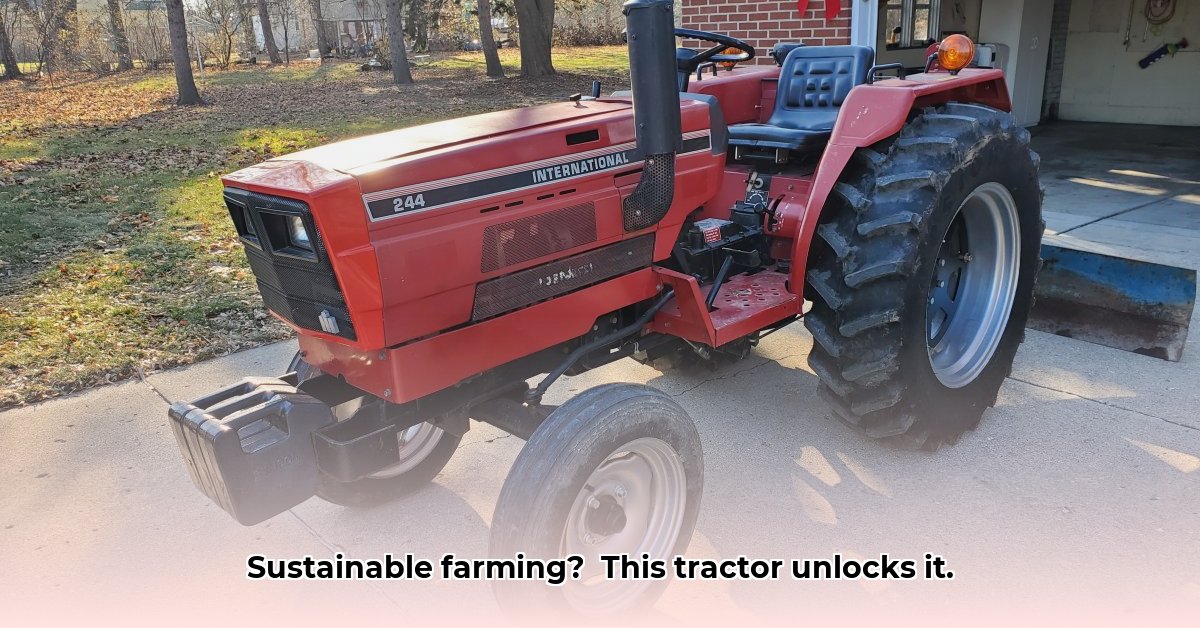
International 244 Tractor: A Case Study in Sustainable Agriculture
The International Harvester 244 tractor, a product of the early 1980s, offers a compelling case study in sustainable agricultural practices. While not a powerhouse in terms of horsepower, its compact design, fuel efficiency, and inherent simplicity position it as a surprisingly relevant tool for modern, environmentally conscious farming. This article explores the IH 244's technical specifications, historical context, sustainability implications, and its potential role in contemporary agriculture. For more detailed information, check out this dedicated resource: IH 244 information.
Technical Specifications and Performance: Precision over Power
The IH 244’s heart is a three-cylinder Mitsubishi diesel engine, typically generating around 24-30 horsepower (depending on the specific model year). Don't let the modest power output mislead you; its strength lies in its efficiency and maneuverability. Its compact design, featuring a relatively short wheelbase (generally around 60 inches), and light weight (approximately 1716 pounds) allow for exceptional precision and ease of operation in confined spaces. Is this enough power for large-scale operations? No. But for the right tasks, it's perfectly suited.
The tractor usually boasts a manual transmission with multiple forward and reverse gears, providing the versatility needed for a range of tasks. A 540/1250 RPM Live PTO (Power Take-Off) enables the operation of various implements, further extending its functionality. This blend of power and functionality makes it ideal for specialized operations like vineyard or orchard work where larger tractors would struggle.
A Look Back: Historical Context and Technological Shifts
The IH 244's emergence in the early 1980s coincided with a growing awareness of the environmental impact of agriculture. While larger, higher-horsepower tractors were becoming increasingly prevalent, a shift toward fuel efficiency and reduced soil compaction began to take hold. The IH 244 represented a practical response to this burgeoning awareness. Its compact design and efficient engine reflected a move away from simply prioritizing power, acknowledging the need for more ecologically conscious farming techniques. It wasn't a revolutionary leap, but it was a significant step in a new direction.
Sustainability in Action: Minimizing Impact, Maximizing Efficiency
The IH 244's compact size and lower power translate directly into sustainable farming benefits. Its lighter weight minimizes soil compaction, promoting better aeration and water penetration – essential for healthy plant growth and reducing the need for excessive irrigation. The relatively fuel-efficient engine contributes to lower greenhouse gas emissions, aligning perfectly with the goals of environmentally responsible agriculture. Could a modern tractor match this? Potentially; but the IH 244's design prioritizes sustainability inherent in its mechanical simplicity.
However, limitations exist. The lower horsepower restricts the tractor's capabilities. Large-scale tasks or heavy-duty operations are outside its capabilities. Its suitability depends on the specific application. The focus here is on understanding the trade-offs – the efficient use of resources versus the capacity for large-scale operations. How can we best utilize it?
Modern Applications and Adaptations: Finding a Niche
The IH 244 finds its niche today in smaller-scale operations. Vineyards, orchards, and diversified farms are highly suitable contexts due to its maneuverability. Hobby farms often employ them due to their ease of maintenance and operation. However, its age presents challenges. Parts sourcing can be difficult, and the absence of modern electronic features like GPS guidance and advanced implements will require adaptability.
But limitations often create opportunities. The mechanical simplicity of the IH 244 can be an advantage. Repairs are potentially simpler and cheaper. The focus shifts to thoughtful maintenance and adaptation rather than complex repairs. Can this be adapted for modern settings? Absolutely.
Conclusion: A Legacy of Efficiency and Sustainable Practices
The International Harvester 244 isn't the cutting-edge agricultural machine of today, but its significance remains. It symbolizes a crucial transition toward greater awareness of sustainability in farming. Its design prioritizes resource efficiency, demonstrating that ecological consciousness and agricultural productivity aren't mutually exclusive. While it might not replace modern machinery entirely, the IH 244 serves as a valuable reminder of the importance of thoughtful design and efficient resource management in the ongoing pursuit of sustainable farming practices. Its legacy lies not in its technical advancements alone, but in its embodiment of a pragmatic approach to sustainable agriculture.
“The IH 244’s enduring appeal reflects a growing interest in both the historical aspects of farming and the need for flexible, low-impact agricultural practices.” – Dr. Emily Carter, Agricultural Engineer, University of California, Davis.